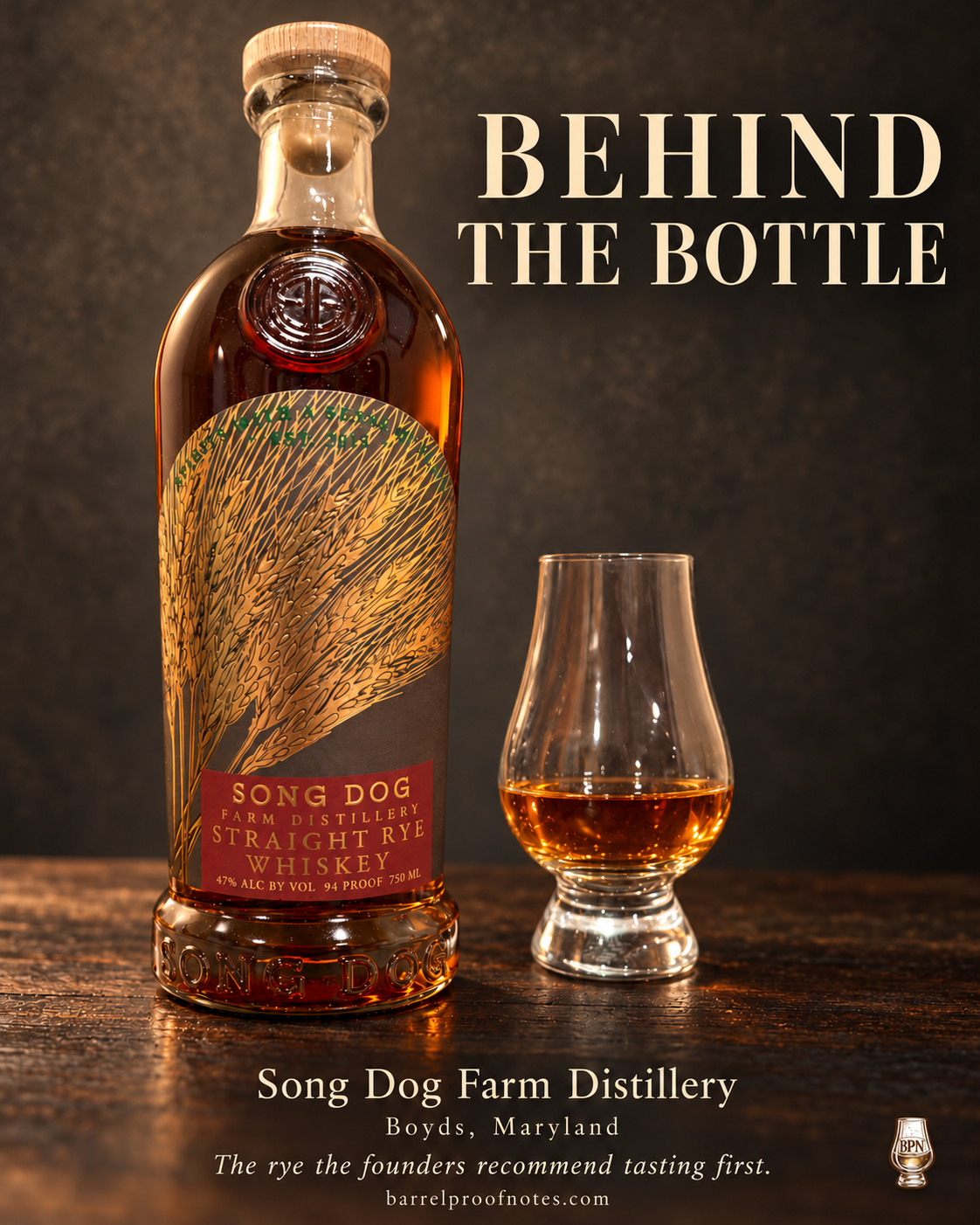
When I asked David Harris and Megan Draheim, distillery founders, which Song Dog Farm whiskey someone should taste first, they smiled, looked at each other, then back at me. There was no debate.
“It is 100% the Rye,” Megan said.
David was a little less diplomatic about choosing favorites. “Someone once said, ‘You don’t know which child you love the most’, well we do. It’s the Rye.”
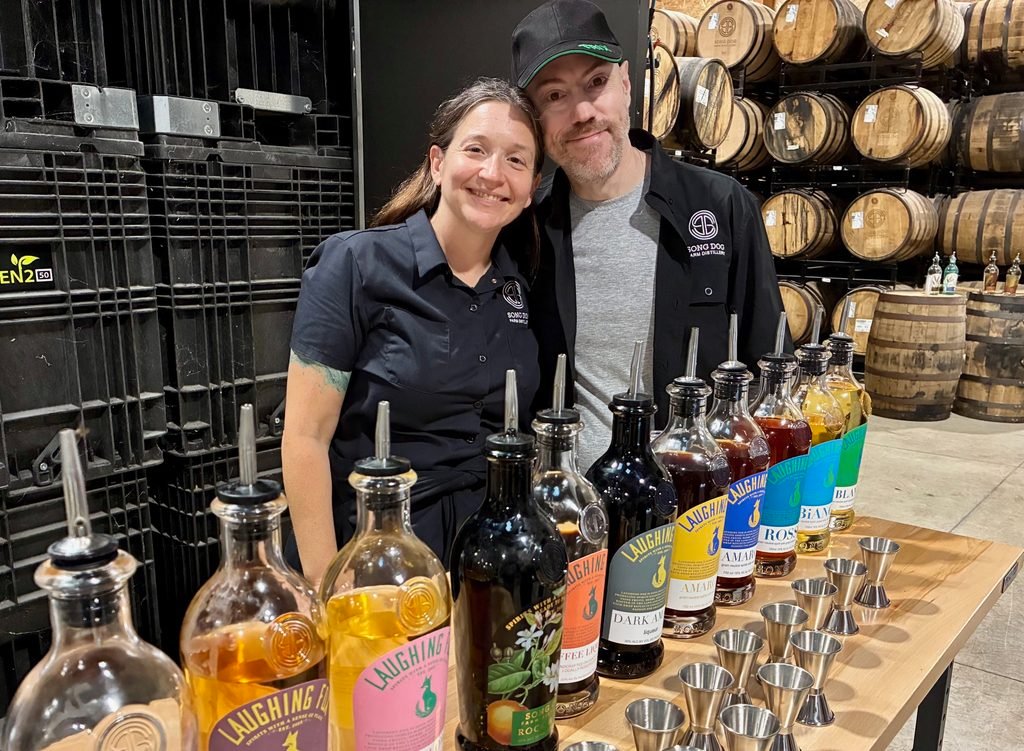
That exchange tells you something about the founders of Song Dog Farm Distillery in Boyds, Maryland. They take their whiskey seriously, but they are comfortable enough with each other, and with their work, to have some fun.
Our conversation kept returning to the grain. Where it grows. How it tastes. What happens when you choose a difficult variety because you believe it makes better whiskey. At Song Dog, those decisions are central to the story behind the bottle.
The People Behind the Bottle
Their account of getting started includes a farmer willing to grow an unusual corn, a still they owned waiting in Germany, and a pandemic that interrupted their plans at exactly the wrong time.
According to David and Megan, everything is now distilled onsite. The distinction matters because their early production story involved partners, and they were open about why.
Before COVID hit in 2020, they were preparing to renovate an industrial building in Rockville, Maryland. Prior to that, they had educated themselves about the science of distillation and developed their own production program.
“We fell in love with the process of distilling,” Megan told me. “We don’t have academic backgrounds in this industry.”
Based on their own research, they selected Bloody Butcher as their corn of choice and had already found a local farmer to grow it. They had their barrels and yeast ready to go. Then the work stopped.
That fall, the farmer arrived with a tractor-trailer load of beautiful ruby-red corn. The grain was ready. Their distillery was not.
David and Megan began calling colleagues for help. They found willing partners at Sagamore and Middle West distilleries.
Sagamore Distillery, located in nearby Baltimore, allowed them not only to participate in production but to control all the variables that mattered to them. Using their own barrels and yeast, they were able to follow their intended production program and control the variables they would have controlled at their own facility.
Megan put it plainly, “They let us control every variable we would control here.”
David’s reply was just as direct, “That’s not normal.”
They experimented with barrel entry proof, char, and toast levels, learning what those choices produced. This was their grain and their intended whiskey program, made possible by other distillers opening their doors.
A Sense of Place
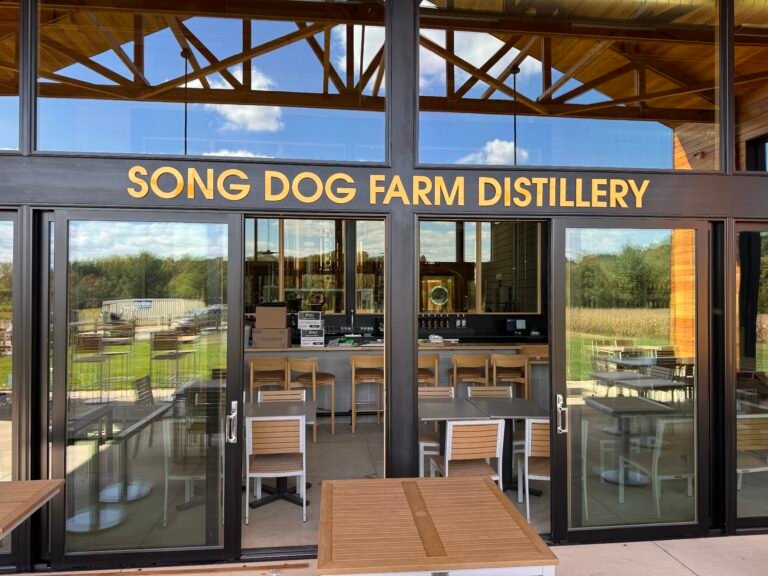
In 2025, after more than ten years of planning and learning, they opened Song Dog Farm Distillery in Boyds, Maryland. The 29-acre location is within the Montgomery County Agricultural Reserve. This site gives visitors the opportunity to see the relationship between the land, the grain, and whiskey made from it. They refer to it as “a sense of place.”
David described looking through panoramic windows at the fields and crops, then through other windows at the grain being distilled. Agriculture and production become parts of the same experience.
When I asked about moving to a farm distillery, Megan answered with the shortest explanation of the interview.
“It’s all about the grain for us.”
They describe themselves as “Terroir Evangelists.” Terroir can sound like a word reserved for wine enthusiasts, but the idea is simply that where an ingredient is grown can help shape its character.
David and Megan have been talking about this concept in relation to spirits for years.
“We just believe deeply that spirits have terroir just as much as wines,” David said.
For Song Dog, that belief begins close to home. Megan said their corn and rye are grown in Montgomery County, with malts coming from a neighboring county in Maryland. They also intend to source their wheat locally.
David acknowledged the uncertainty that comes with committing to a place and a production approach before knowing exactly how the finished whiskey will taste.
“The flavor of this place is the flavor of THIS place. There is something scary about that.”
That is a refreshingly candid thing for a founder to say. Local grain can give a whiskey a story. The harder task is making a whiskey that gives people a reason to care about the grain.
How They Make Their Whiskey
One of Song Dog’s defining choices began at a conference, where David and Megan tasted distillates made from different corn varieties, including Bloody Butcher.
“We just fell in love with the taste of the Bloody Butcher,” Megan said.
Even though it has lower yields and is more difficult to grow for a number of reasons, they chose it anyway because, in their judgment, the flavor justified the trouble. David calls the result “a richer distillation.”
Their rye raises another question. What makes a whiskey Maryland rye?
Megan acknowledged that people disagree about the historic style. Song Dog’s recipe, she said, is 90 percent rye and 10 percent malt.
“Our belief is Maryland Rye is made in Maryland from Maryland grown rye.”
It is a clear statement of their philosophy without requiring every Maryland distiller to agree on one historical recipe. They also said they are participating in a University of Maryland study to identify which rye varieties grow well in their state and taste good.
Then there is their “solera-inspired” blending process. That phrase deserved an explanation, and David gave one.
For both their bourbon and their rye, he described combining small batches of barrels in a larger tank, usually four and no more than nine. The whiskey rests, is proofed, and is allowed to marry before bottling. They draw off about half, leaving the remainder for subsequent batches.
Traditionally associated with sherry, a solera system blends wine from different stages of aging. A portion is drawn from the oldest group of barrels for bottling, then replaced with wine from the next-youngest group. That process continues through the system, with young wine replenishing the youngest group. The barrels are only partially drawn down, allowing older and younger wine to mingle and helping maintain a consistent character over time.
In the modified Song Dog blending system, the whiskey retained in the blending tank connects one batch to the next. David likes to think that some of their earliest bourbon and rye remains in their respective tanks and eventually makes its way into every bottle through this process.
He also made the qualification himself: “It in no way technically meets the definition of a Solera system.”
The Experience Beyond the Bottle
The farm distillery location brought another learning curve… welcoming people.
Megan said the farm, roughly 45 minutes from the heart of Washington, DC, gives visitors another reason to come out and learn about local agriculture. David wants them to experience the connection between the fields and distillation.
But hospitality has developed into something more personal than explaining how whiskey is made.
“It has been really really gratifying to see people sharing their special moments with us,” Megan said.
She mentioned engagement, birthday, and retirement parties. Those occasions have given the founders another aspect of the business to develop, and another reason to think carefully about what visitors experience.
There is a similar openness in the way they described the distilling community. Megan praised the Maryland Distillers Guild and the willingness of other producers to share results and help one another.
David’s view is that a recipe alone cannot reproduce everything that makes a whiskey its own. The people, ingredients, equipment, and decisions still matter, but the relationship with the land and grain also shapes what is expressed in the whiskey.
What Comes Next
At the time of our interview, Megan said Song Dog was expanding sales in Maryland, the District of Columbia, and Chicago. That last city has a personal connection for her as she is originally from Chicago.
David said online sales had also launched. Looking further ahead, he mentioned a single malt, while Megan suggested a malted rye could be in the works sometime in the future.
Megan also wants to refine the hospitality side of the farm.
The work ahead includes both what goes into the glass and what makes people feel welcome when they arrive.
The First Pour
So why did both founders choose the rye when asked what bottle someone new to Song Dog Farm Distillery should pour first?
Megan said it has connected with committed rye drinkers and with people who approached the category cautiously. Some expected a whiskey that would be too spicy, harsh, or difficult to enjoy. Their reaction, she said, was much more positive.
David described it as “a gateway to rye.”
“It is balanced and nuanced. It’s complex, but not overly complex. It’s not overwhelming.”
That is their description of the whiskey, and their recommendation for where to begin. A Barrel Proof Notes tasting review will stand on what we find in the glass.
What stayed with me from the interview was how willingly David and Megan explained their decisions. They talked about an inconvenient crop, an interrupted start, the help they received, and the uncertainty of betting on a particular place.
As Megan said, “It’s all about the grain for us.”
At Song Dog, understanding that means understanding the people who chose it and the place they want it to represent.