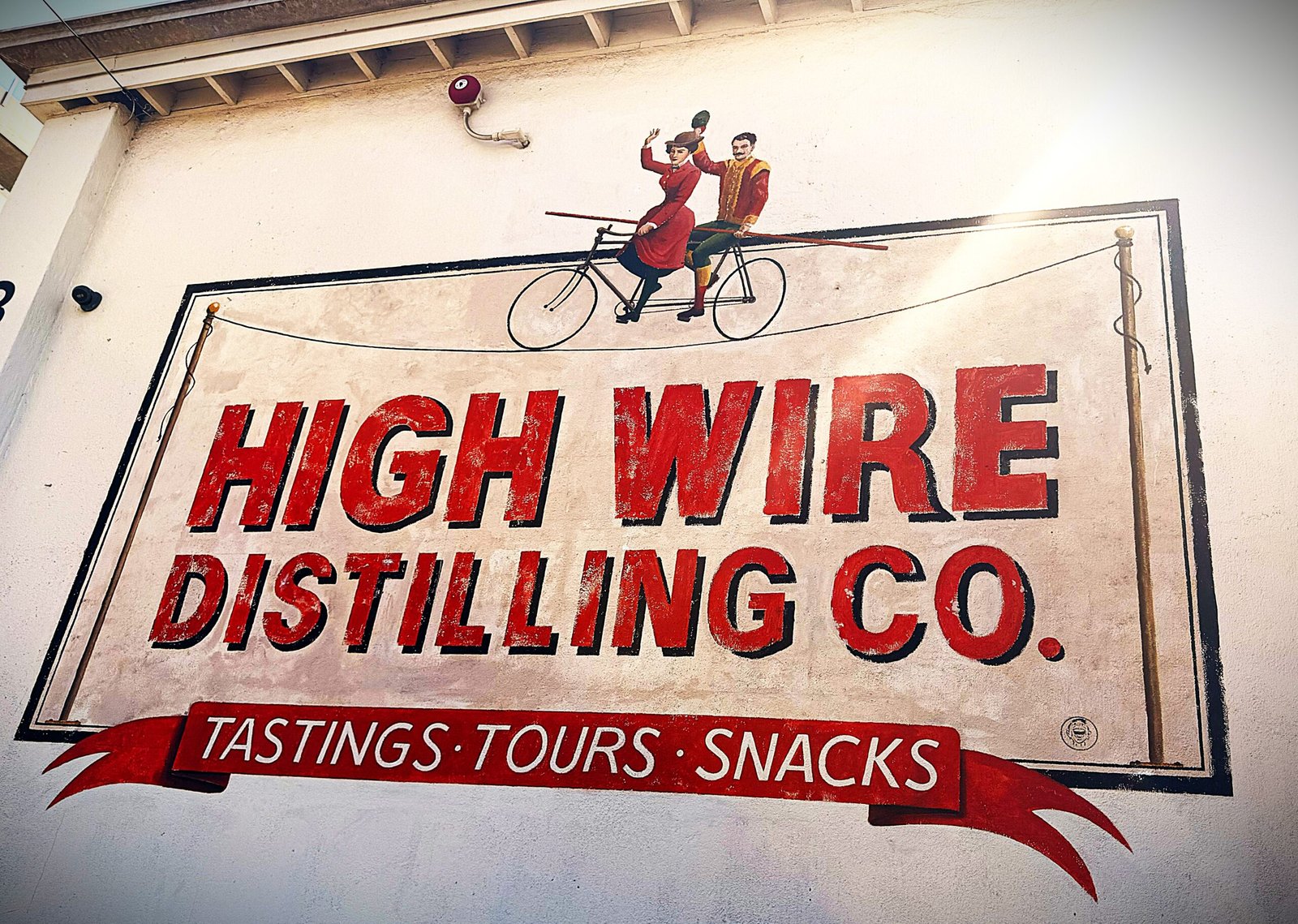
At High Wire Distilling “local grain” is more than a line on the label. The identity of the farmer, and sometimes even the field where the corn was grown, can follow the grain all the way into the aging warehouse.
There are plenty of things written on a bourbon barrel. A barreling date. A mash bill. A barrel number. Maybe a warehouse location.
At High Wire Distilling in Charleston, South Carolina, we found something else.
The farmer’s name.
On one barrel head, the farmer had personally signed his name and written the location of the field where the corn inside that barrel had been grown. That stopped us.
Because after hearing High Wire talk about South Carolina agriculture, heritage grain, individual farms, and the idea that whiskey can express a sense of place, here was the philosophy reduced to something remarkably simple. A farmer grew the corn. High Wire made the whiskey. And years later, the farmer’s name was still traveling with it. That may tell you more about High Wire Distilling than anything else we saw that afternoon.
FIELD NOTES
DISTILLERY: High Wire Distilling Co.
LOCATION: Charleston, South Carolina
FOUNDED: 2013
FOUNDERS: Scott Blackwell and Ann Marshall
KNOWN FOR: Jimmy Red Bourbon, heritage grains, South Carolina agriculture, and an ingredient-first approach to distilling
WHY WE STOPPED: To find out whether High Wire’s story about grain, farmers, and place actually carries through the production process…It does.
A Window Into the Distillery
Our visit started easily enough. Anyone who has driven around Charleston knows that convenient parking can occasionally feel like an achievement. High Wire’s Huger Street location was easy to reach, and we walked inside to find a large tasting room with a comfortable bar and enormous windows looking directly onto the production floor.
Dominating that view was a massive copper pot still connected to a towering distillation column. His name is Carl.
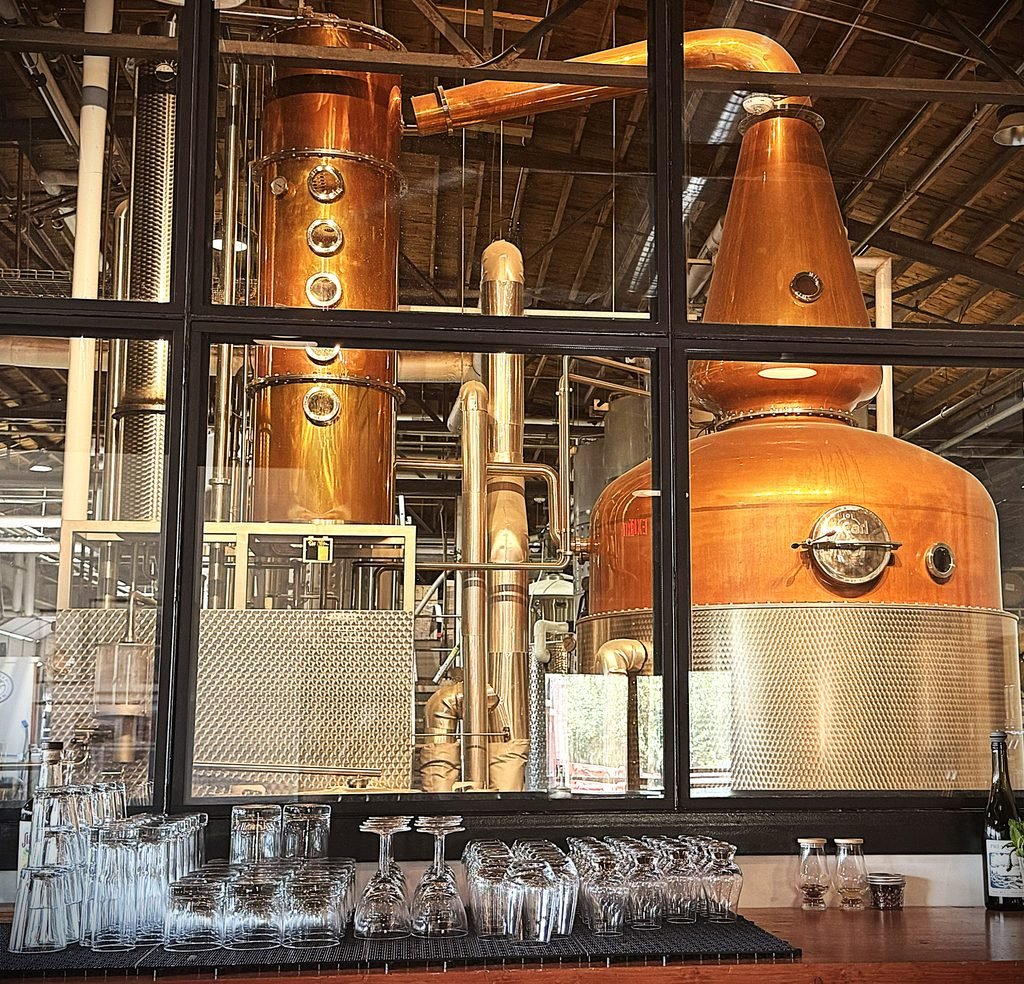
Our guide for the afternoon was longtime High Wire employee Katie Daniel, who gave us a one-on-one tour and an unusually detailed look at how the distillery operates.
After a short introductory video explaining founders Scott Blackwell and Ann Marshall’s vision, Katie took us behind those big windows and onto the production floor. Carl was even more impressive up close.
Tucked behind him was Nadine, High Wire’s smaller original hybrid still. Nadine came from the distillery’s earlier location and remains part of the operation today. Carl provides the capacity for the larger production runs, while Nadine gives High Wire the flexibility to handle smaller batches, experimental runs, and special projects. That combination tells you something about where High Wire is today. This is no longer a tiny startup distillery, but experimentation clearly hasn’t disappeared as the business has grown.
The Ingredient Comes First
Founded in 2013 by husband-and-wife team Scott Blackwell and Ann Marshall, the distillery describes itself as agriculturally focused, with an emphasis on forgotten grains, South Carolina farms, seed preservation, and flavor. There bourbon mash bill is 100% Jimmy Red corn, an heirloom corn historically associated with nearby James Island that came dangerously close to disappearing.
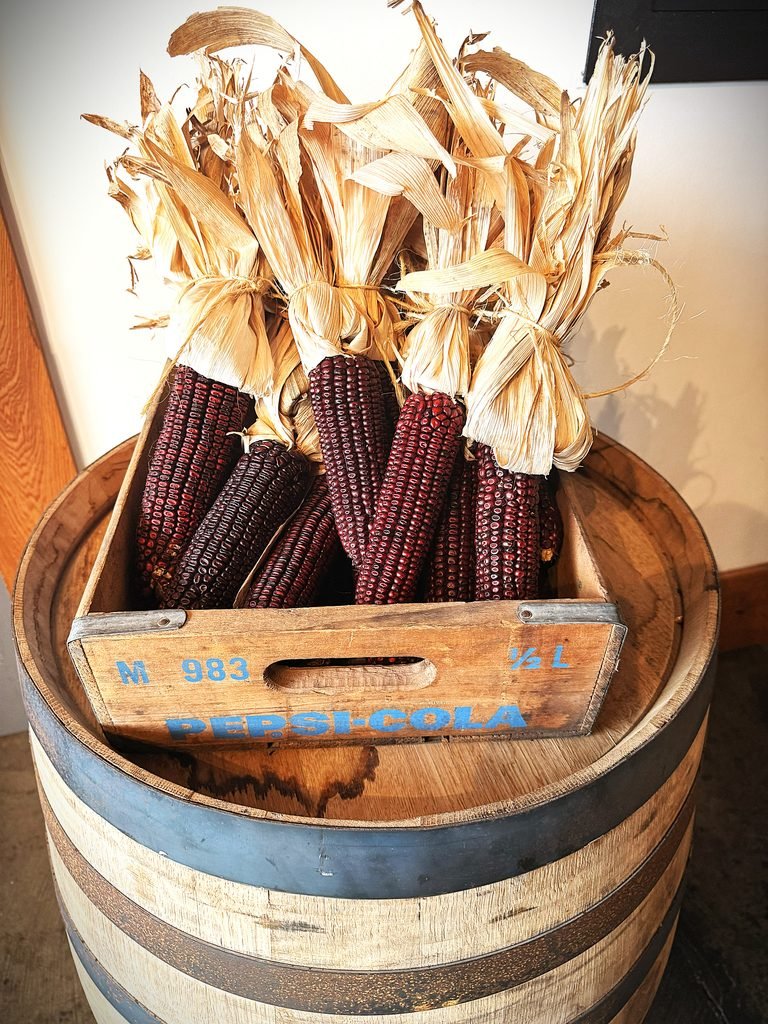
When High Wire began working with the grain in 2014, Glenn Roberts of Anson Mills provided seed for an initial 2.5-acre planting conducted in partnership with Clemson University. That first crop produced enough corn for only two batches of whiskey. High Wire says annual production has since grown to more than 1.3 million pounds.
It’s a remarkable story. But we aren’t going to tell the entire Jimmy Red story here. It deserves more room than that, and we will return to it elsewhere. What interested us during this visit was what High Wire does after the corn arrives.
They want to know who grew it.
Following the Corn Back to the Farm
Katie took us outside to the receiving area, where a large grain bin stood beside the production building. This is where local farmers deliver High Wire’s signature Jimmy Red corn by the truckload.
Katie explained that approximately five local farms currently supply the Jimmy Red used by the distillery. More importantly, High Wire doesn’t simply combine all of that corn into one anonymous grain supply. The corn from different farms is processed separately.
According to Katie, Scott and Ann believe that individual farms can impart differences in the grain such as oil content and ultimately in the resulting spirit. She told us they have become familiar enough with those differences that they can identify the sourced farm by the aroma and taste of the distillate. That’s a bold claim.
The whiskey world increasingly uses the word terroir, borrowing from wine the idea that geography, soil, climate, agriculture, and human decisions can become identifiable in the finished product.
It’s an interesting idea. It’s also one that deserves some skepticism when applied to a spirit that then spends years interacting with a heavily charred oak barrel. But High Wire isn’t merely talking about terroir. They’re trying to preserve enough information to explore it.
Then We Saw the Barrel
After receiving, the grain moves through the production process entirely at High Wire. The corn is milled on site, mashed, fermented, distilled, and eventually put into barrels in Charleston. High Wire says all of its spirits are produced from mill to barrel at the downtown distillery. Katie showed us the milling operation and walked us through how the grain moves from one stage to another. Then we entered the barrel area.
Rows of whiskey filled the space. The barrels carried the information you would expect to see: production details, mash information, dates.
And then we noticed the names. The farmers were identified on the barrels. One went farther. The farmer had signed the barrel head himself and added the farm and specific field number where the corn had been grown.
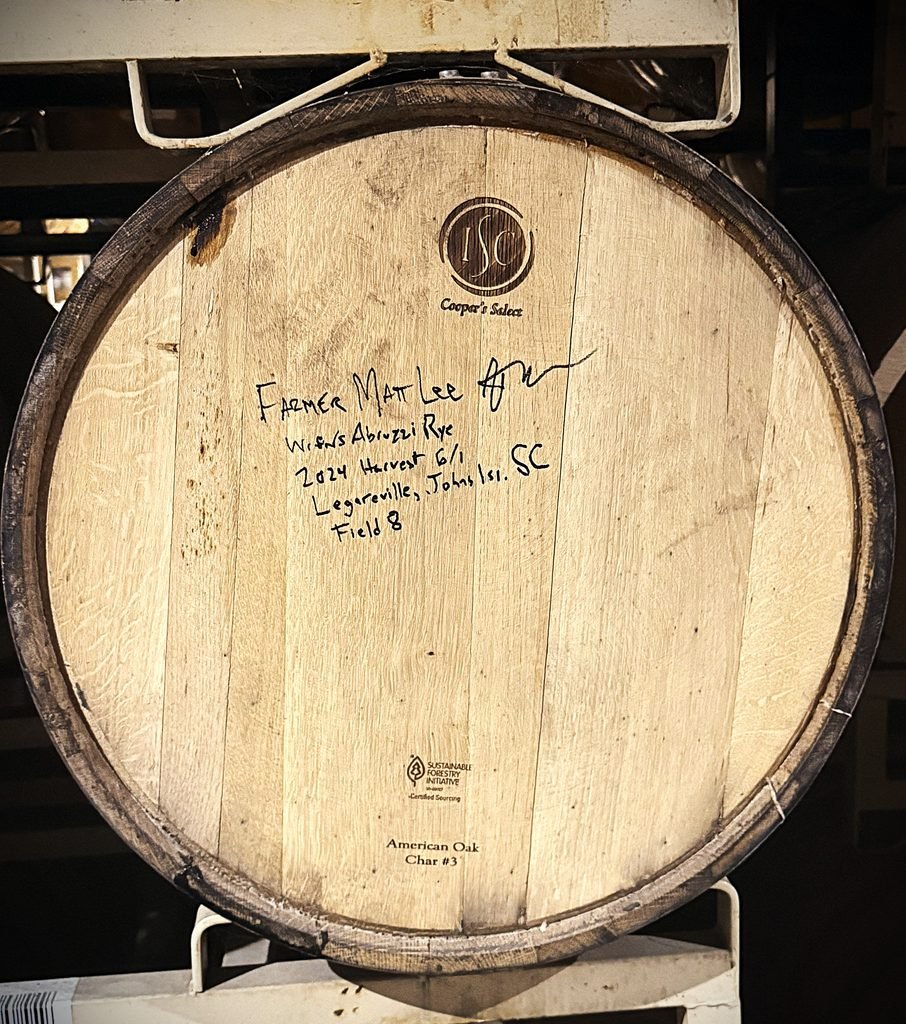
That changed the story for us. It is easy for a distillery to say it supports local agriculture. It is another thing to maintain the identity of the person who grew the grain far enough through production that his name is still sitting on a barrel of aging bourbon years later. That barrel was no longer simply holding whiskey. It was holding a chain of custody.
Seed. Farm. Farmer. Grain. Distillery. Barrel.
That is where High Wire’s philosophy became tangible.
Can a Whiskey Have an Address?
High Wire likes to talk about whiskey as an expression of place. After walking through the operation, we understood the argument better. The company’s flagship Jimmy Red Bourbon is made from 100 percent Jimmy Red corn, grown in South Carolina and distilled in Charleston. High Wire says the whiskey is aged at least four years in American oak. But the more interesting question isn’t whether Jimmy Red is unusual. It is whether place survives the process.
Can corn grown on one South Carolina farm taste meaningfully different from the same variety grown somewhere else? Can that difference survive milling? Fermentation? Distillation? Years inside a charred barrel?
Those are much more interesting questions than simply asking whether Jimmy Red makes good bourbon. And High Wire appears willing to keep asking them.
Scott Blackwell has previously said that when their earliest Jimmy Red distillate came off the still, it was noticeably different from spirit they had produced from yellow corn, white corn, and other heirloom varieties. High Wire’s farm-by-farm production philosophy takes that curiosity another step.
They aren’t only asking whether variety matters. They’re asking whether farm matters.
That’s the kind of experimentation we want to see happening in American whiskey.
More Than One Red Corn
Jimmy Red receives most of the attention, but focusing exclusively on it misses the larger point. High Wire’s philosophy extends beyond one celebrated grain.
Its Revival Rye is made with locally sourced Wrens Abruzzi rye, an aromatic variety that has been grown in the Carolinas for generations. The distillery also works with regionally grown and foraged ingredients in other spirits. That tells us Jimmy Red isn’t simply a clever product story.
The ingredient-first approach is the story.
High Wire asks what happens when a distiller begins with something that belongs to a place and then builds the spirit around it. Sometimes the answer is bourbon. Sometimes it’s rye. And sometimes High Wire’s curiosity goes in considerably stranger directions. We’ll get to one of those shortly.
The Tasting Room
Our walking tour ended where it began in the Tasting Room with big Carl towering over us on the other side of the large windows. Our walk was over, the the journey was not done.
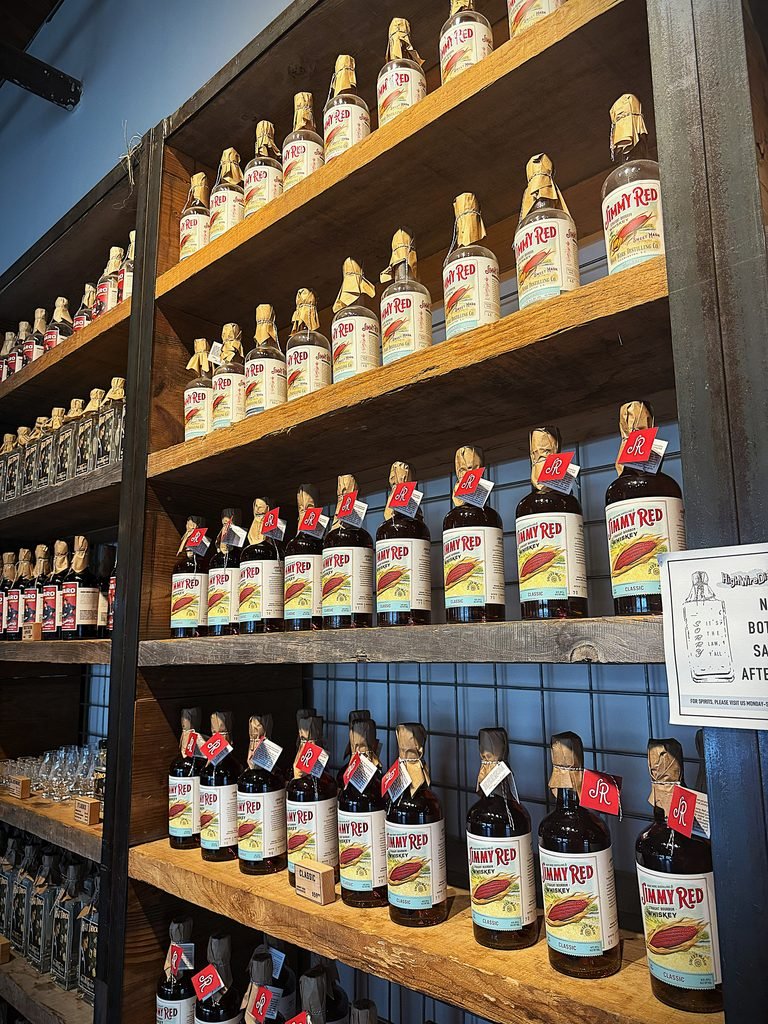
In the Tasting Room, we sampled Jimmy Red Classic, Jimmy Red Double Oak, and a particularly unusual expression called Benton’s Smoked Bourbon. We’re deliberately not reviewing them here. These bottles deserve their own Tasting Notes articles, where we can judge what’s actually in the glass without turning a Route One Corridor feature into a product roundup.
The story behind the Benton’s Smoked Jimmy Red Bourbon needs an article of its own. This experimental expression involves Jimmy Red corn and Benton’s Smoked Meats, one of the South’s legendary smokehouses. It deserves considerably more than a paragraph buried at the bottom of another story. So we’ll leave that bottle sitting on the shelf for now. But we’re coming back to it soon.
Whiskey as Agriculture
Founder Scott Blackwell uses a phrase that initially sounds almost philosophical, “Drinking is an agricultural act.”
Spend an afternoon following their process and the meaning becomes clearer. Long before bourbon reaches a Glencairn, somebody has to grow something. A farmer chooses seed. A field is prepared. Weather intervenes. The crop is harvested. Grain is delivered. Then the distiller finally gets involved. By the time whiskey reaches most consumers, nearly all of that history has disappeared. All some see is a bottle on a shelf.
High Wire and other craft distillers like them are determined to move as much of that history as possible back into the picture. That’s why that signed barrel head stayed with us. It connected the bottle we eventually taste to an actual person standing in an actual field somewhere in the Lowcountry of South Carolina. There is something refreshingly honest about that.
Why High Wire Matters to the Route One Corridor
Barrel Proof Notes created the Route One Corridor series to find American whiskey stories that exist outside the industry’s usual gravitational center. Not because Kentucky doesn’t matter. It matters enormously.
But good American whiskey has never belonged exclusively to one state, and some of the most interesting work happening right now begins with distillers asking what should whiskey from their own place look and taste like.
High Wire is doing exactly that. Take South Carolina out of this story and you don’t simply change the address printed on the bottle. You change the farmers. You change the grain. You change the agricultural relationships. You change the Lowcountry connection that led High Wire to Jimmy Red in the first place. And ultimately, you may change the whiskey.
The change occurs because the story is held together by the chain of People – Place – Agriculture – Process – Whiskey..
Where the Farmer’s Name Goes on the Barrel
We arrived at High Wire expecting to learn more about Jimmy Red. We did. But that isn’t what we carried away from Charleston. We left thinking about a barrel. A farmer had signed it. He had written where his field was located. Somewhere before that barrel existed, seed went into South Carolina soil. A crop grew. Someone harvested it. High Wire received it separately from grain grown on neighboring farms, milled it, fermented it, distilled it, and put the resulting spirit into oak. Then they left the farmer’s name on the barrel. Years from now, somebody will pour the whiskey. They may never know the farmer’s name. But High Wire does.
And after visiting the distillery, we think that matters. Because good whiskey doesn’t really begin at the still. Sometimes it begins in a field. And if you’re willing to take the scenic route, sometimes you can follow it all the way from the farmer’s name to the glass.