What do all those whiskey medals really tells us
Maybe you’ve seen a bottle proudly declaring Double Gold or a distillery announcing that its bourbon just won Platinum at the San Francisco World Spirits Competition.
Sounds impressive, doesn’t it? But what does it actually mean?
Is Double Gold twice as good as Gold? Does Platinum mean the whiskey is practically perfect? And who are these people deciding which whiskeys deserve all that shiny hardware?
As whiskey enthusiasts, we hear plenty about award-winning bourbon. We hear considerably less about how those awards are earned.
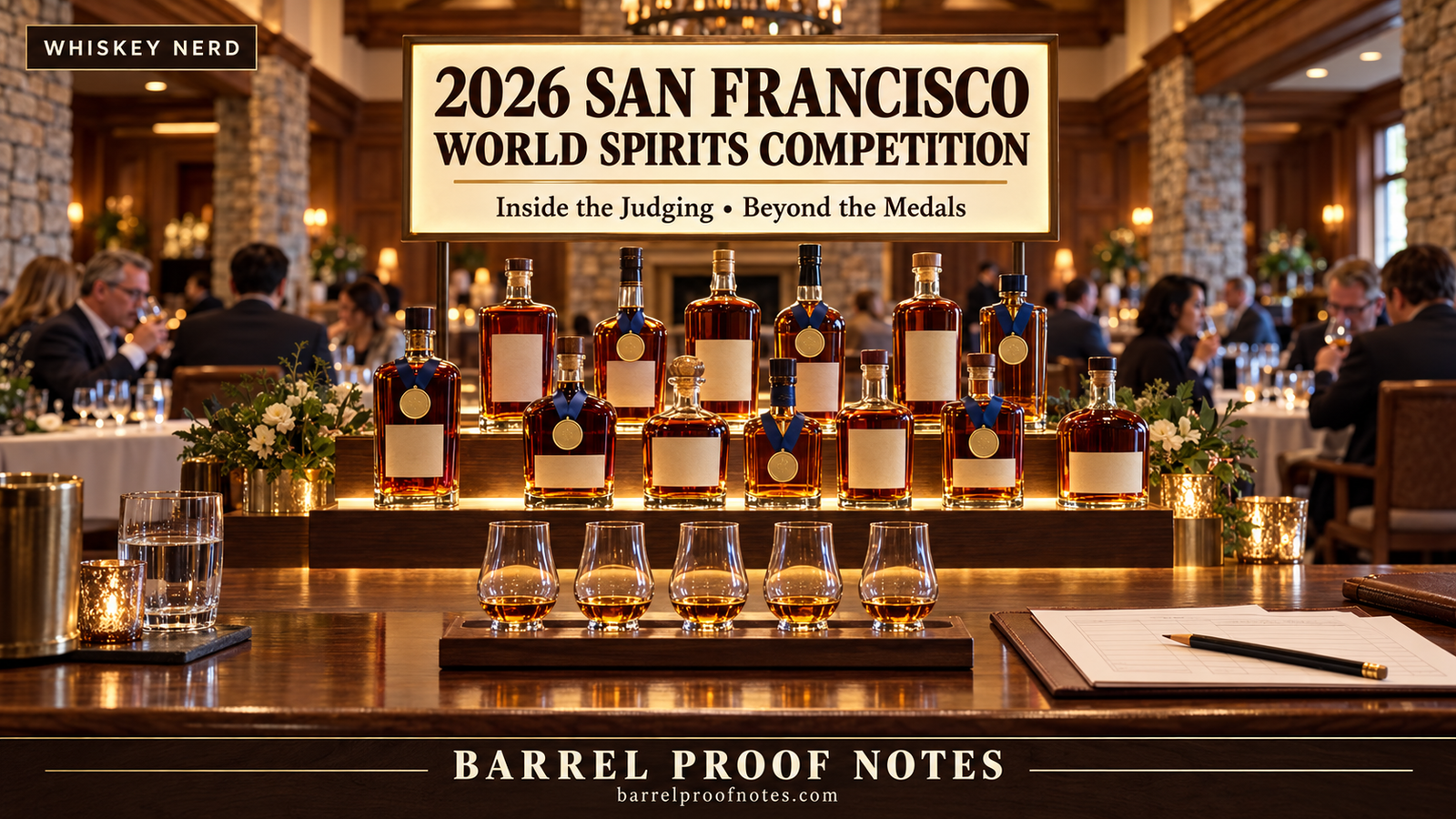
So, let’s take a closer look at one of the spirits industry’s best-known competitions, meet the judges, explain the medals, and find out what those awards really tell us about the whiskey in our glass.
San Francisco’s Big Spirits Competition
The San Francisco World Spirits Competition, commonly called the SFWSC, was established in 2000 and is organized by The Tasting Alliance.
Over the years, it has grown into one of the world’s most recognized spirits competitions, attracting thousands of entries from producers around the globe.
And this is much bigger than bourbon.
Whiskey competes alongside categories devoted to tequila, rum, gin, vodka, brandy, and numerous other spirits.
For bourbon and rye enthusiasts, the competition offers an annual opportunity to see how participating whiskeys perform when evaluated by experienced industry professionals.
But here’s something worth understanding.
The competition doesn’t judge every bourbon made in America. It judges the products that producers choose to enter.
That’s an important distinction.
An outstanding bourbon might never appear in the results because its producer didn’t submit it. And a distillery entering five expressions has five opportunities for recognition, while another entering only one has just one.
The medal count tells us something about the whiskeys submitted. It doesn’t necessarily tell us which distillery makes the best whiskey overall.
No Labels. No Marketing. Just Whiskey.
Imagine walking into a room filled with experienced whiskey judges.
In front of them are glasses containing spirits from distilleries around the world.
Some might contain whiskey from historic Kentucky producers. Others might hold bourbon made by a small family operation in North Carolina or rye distilled in Maryland.
The judges don’t get to admire the bottle. They don’t see the elaborate packaging, the familiar logo, or the photograph of a legendary master distiller.
They’re evaluating the liquid through blind tasting.
Entries are organized into appropriate categories and flights so that spirits are assessed against reasonably comparable products.
The judging panels include experienced spirits professionals who evaluate qualities such as aroma, flavor, balance, complexity, and finish.
Sound familiar?
Those are many of the same considerations we use in our Barrel Proof Notes tastings.
The difference is that SFWSC uses panels of judges, while our Barrel Proof Score is an independent editorial judgment that places particular emphasis on flavor and finish.
Blind tasting helps remove the influence of reputation, price, and packaging.
It doesn’t make human taste completely objective, but it does give an unfamiliar producer an opportunity to impress on the merits of the whiskey itself.
And that’s something we appreciate.
What Do the Medals Actually Mean?
Here’s where things get interesting.
Unlike the Olympics, where someone finishes first, second, or third, the San Francisco World Spirits Competition can award multiple medals at the same level.
The judges are evaluating whether an entry meets the quality standards for a particular award.
There can be dozens of Gold winners, multiple Double Gold winners, and numerous Silver recipients.
Here’s how the system works.
Bronze: Recognition for a spirit considered worthy of a medal, although it doesn’t reach the higher award levels.
Silver: A commendable spirit demonstrating good quality.
Gold: A spirit demonstrating a high standard of quality.
Double Gold: The real distinction is unanimous agreement. Every judge on the panel must independently award the spirit Gold.
Now, stop there for a moment.
Double Gold does not mean the whiskey scored twice as high as Gold.
It means every judge agreed that the whiskey deserved Gold recognition.
Considering how differently even experienced whiskey enthusiasts can perceive the same bourbon, that kind of agreement is meaningful.
Platinum: This award recognizes a spirit that earns Double Gold in the same competition for three consecutive years.
Think about that.
One year of unanimous Gold recognition is impressive. Repeating it for three consecutive competitions suggests a sustained level of quality, even though the whiskey submitted each year may come from a different batch.
Of course, a Platinum award doesn’t mean you’ll personally love that whiskey.
But it does tell us something about its record with the judges.
And Then There’s Best of Class and Best in Show
The medals aren’t the end of the competition.
Double Gold winners can advance into additional judging rounds for higher distinctions.
Best of Class recognizes the leading spirit within a defined competitive category.
For bourbon, those categories can distinguish straight bourbon, wheated bourbon, single-barrel bourbon, and other specific styles or age classifications.
Best in Show takes the competition another step further by recognizing an outstanding spirit among the top contenders in the applicable competition division.
Think of it this way.
A Gold medal tells us the judges considered a whiskey to be of high quality.
Double Gold tells us every judge agreed.
Platinum recognizes that the same expression has achieved that unanimous Gold recognition three years in a row.
Best of Class and Best in Show go beyond those individual medal standards and identify winners in head-to-head comparisons among exceptional entries.
That’s why a Best of Class award can be particularly meaningful.
The whiskey isn’t simply meeting an established quality standard. It’s being selected over other highly regarded competitors.
Does Double Gold Mean It’s Better Than Your Favorite Bourbon?
Here’s the question every whiskey enthusiast should consider.
Suppose a bourbon earns Double Gold in San Francisco, but your favorite everyday pour earns Silver.
Does that mean the judges are right and you’re wrong?
Not at all.
A competition award measures how a panel of judges evaluates a particular entry under specific conditions.
Your personal enjoyment depends on your preferences, your palate, and the characteristics you appreciate most.
Some enthusiasts love big barrel-proof bourbons with intense spice and a long finish.
Others prefer softer wheated bourbons with rich vanilla, caramel, and baking spices.
Neither palate is wrong.
And the same whiskey can make very different impressions depending on the person tasting it.
That’s why medals are useful information, but they shouldn’t replace independent reviews or your own judgment.
At Barrel Proof Notes, our approach remains the same.
Honest Scores for Your Pours.
We evaluate appearance, aroma, flavor, and finish, with flavor and finish carrying the greatest influence on our overall editorial score.
A medal might make us curious about a bourbon.
It doesn’t determine our opinion.
One Last Pour
There’s something encouraging about the idea that a small, relatively unknown distillery can enter an international spirits competition and compete alongside some of the biggest names in the industry.
Great whiskey isn’t confined to one state, one mash bill, or one familiar name.
Sometimes it comes from a famous Kentucky rickhouse.
Sometimes it comes from a former prison in North Carolina.
And sometimes it comes from a small distillery that most bourbon enthusiasts haven’t discovered yet.
That’s what makes blind competitions like the San Francisco World Spirits Competition interesting.
They give us another way to discover whiskey, learn about producers, and appreciate the craftsmanship behind a great pour.
But remember, an award is an informed opinion, not a guarantee that you’ll love what’s in the glass.
The next time you see a shiny Double Gold medal on a bourbon bottle, you’ll know a little more about what it means.
And perhaps more importantly, what it doesn’t.
One last question for our fellow whiskey enthusiasts: Have you ever tasted a highly awarded bourbon that disappointed you, or discovered an unheralded whiskey that absolutely deserved a medal?
We’d love to hear about it.
Barrel Proof Notes | Honest Scores for Your Pours.