THE ROUTE ONE CORRIDOR | AMERICUS, GEORGIA
From a holiday experiment among friends to Georgia’s oldest continuously operating post-Prohibition distillery, 13th Colony has built its identity one hot South Georgia barrel at a time.
When bourbon drinkers talk about the places that shape American whiskey, the conversation usually begins in Kentucky. It may wander west to Indiana or south to Tennessee.
Americus, Georgia, does not often come up.
Perhaps it should.
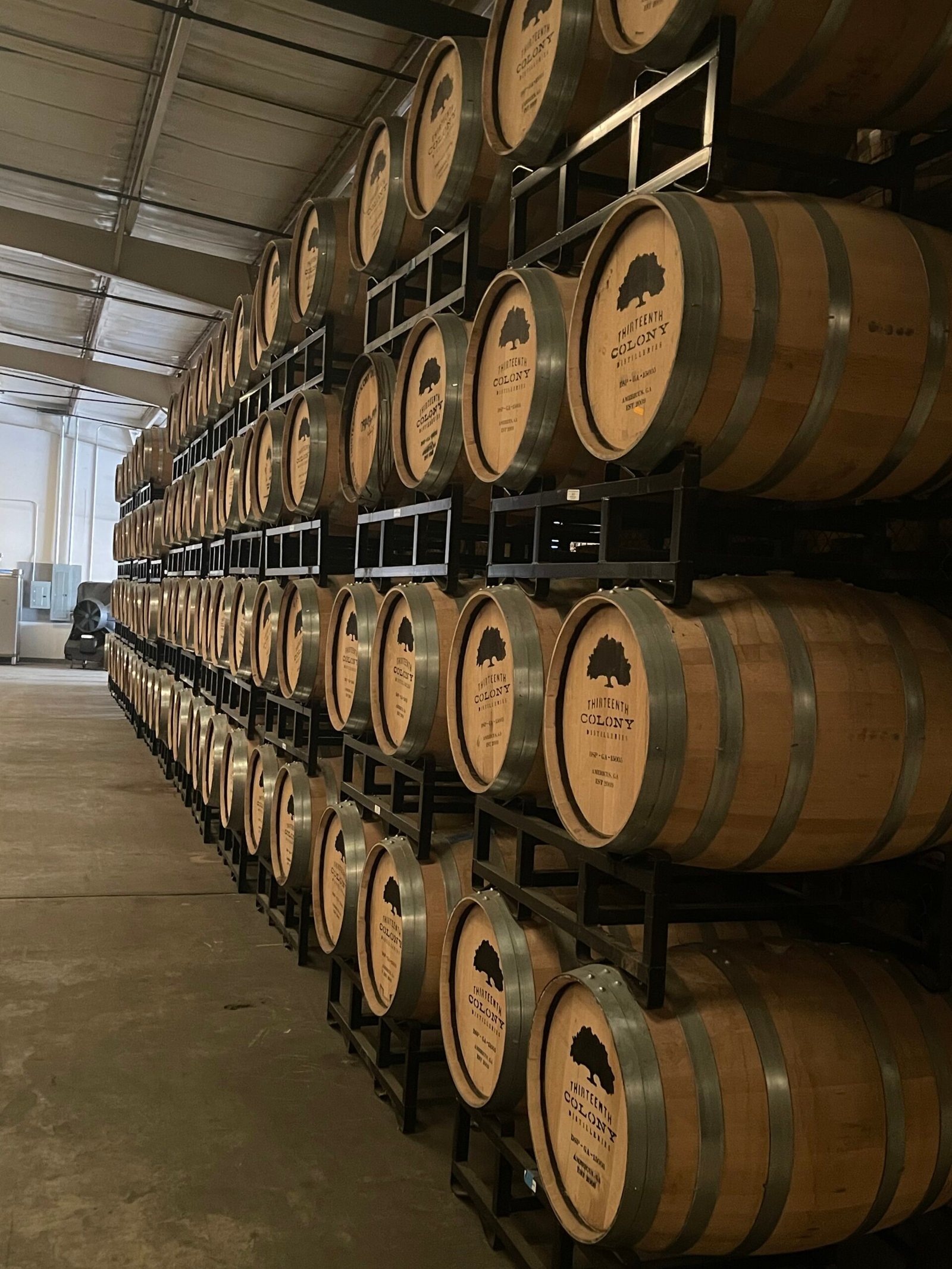
Follow the scenic route into South Georgia and you’ll find a distillery doing something distinctly its own. At 13th Colony Distilleries, the relentless summer heat, heavy humidity, and temperature swings of Americus aren’t background scenery. They’re part of the whiskey-making process.
Here, barrels breathe hard. Whiskey works its way into oak and back again. Proof concentrates. Color deepens. And the person deciding when those barrels are ready isn’t watching the calendar nearly as closely as he’s tasting what’s inside them.
That relationship among place, wood, weather, and taste has helped turn a holiday experiment among friends into one of the most compelling whiskey stories along the Route One Corridor.
This is why we’re taking the scenic route.
ROUTE ONE FIELD NOTES
DISTILLERY: 13th Colony Distilleries
LOCATION: Americus, Georgia
FOUNDED: 2009
PRESIDENT: Maxwell “Max” Darby
MASTER DISTILLER: Graham Arthur
KNOWN FOR: Southern Bourbon, Southern Rye, 113 Series, Double Oaked and Barrel Symphony
WHY WE STOPPED: South Georgia maturation, independent ownership, creative blending and an increasingly distinctive regional whiskey identity
A Distillery Born Among Friends
The story began in 2009 when a group of friends started talking about making spirits as holiday gifts for family and friends. There was only one problem: doing it casually at home wouldn’t be legal.
Most people probably would have abandoned the idea.
Instead, they started a distillery.
Among the original founders was the late Alton Lee Darby, an Americus businessman whose entrepreneurial curiosity and gift for making people feel welcome helped establish the character of the company. The original thought was simple: if they could make spirits for the friends they already knew, why not make them for the friends they hadn’t met yet?
That informal beginning grew into 13th Colony Distilleries, named in recognition of Georgia’s place as the thirteenth of the original American colonies. Founded in 2009, the company identifies itself today as Georgia’s oldest continuously operating distillery of the post-Prohibition era.
The company remains connected to the same circle of family and friends who helped create it.
The second generation is now helping carry that idea forward. Alton Darby’s son, Maxwell “Max” Darby, joined the business and became its president, guiding 13th Colony from a respected Georgia producer toward a broader national audience.
The family connection matters, but so does the original spirit of friendship.
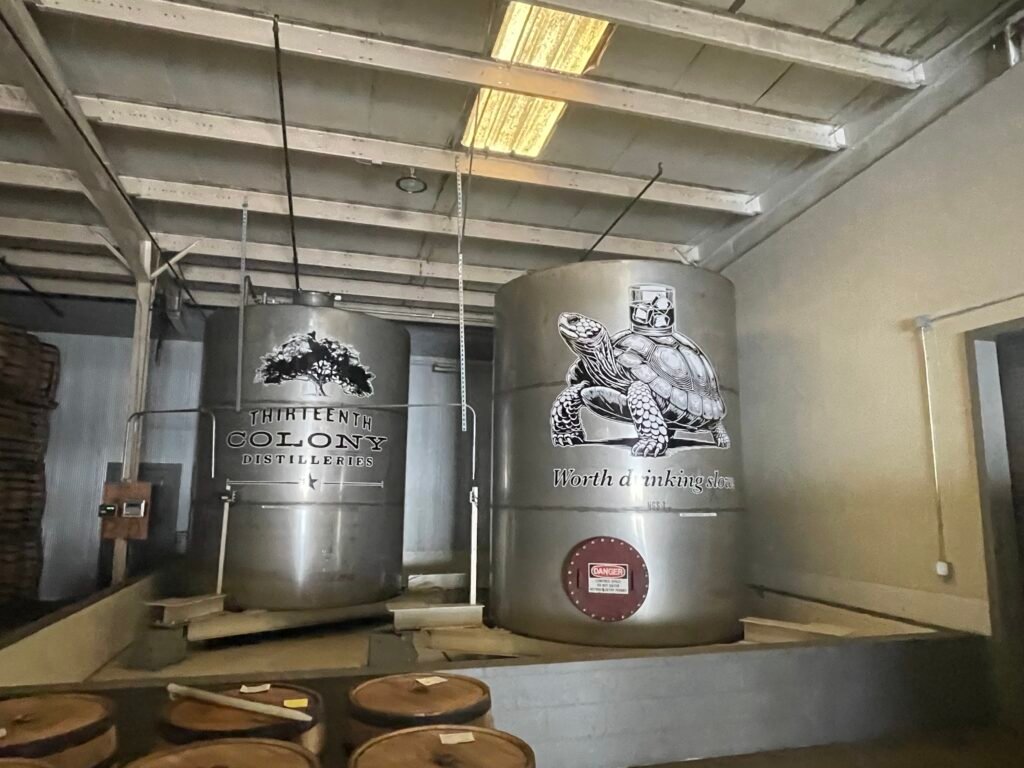
The distillery still operates from a practical, no-frills warehouse in Americus. It feels less like a polished corporate whiskey campus and more like a place where people roll up their sleeves and get to work.
That fits 13th Colony perfectly.
Americus: A Small City With a Long Story
Americus is the county seat of Sumter County in southwest Georgia, approximately nine miles east of Plains and about 150 miles south of Atlanta. The city sits among the farmland, pine woods, and small communities that define this part of the state.
Incorporated in 1832, Americus grew into an important railroad and commercial center during the nineteenth century. The grand Windsor Hotel, completed in 1892, still rises above downtown with its Victorian towers and balconies. Nearby are Plains, the hometown of President Jimmy Carter, and Andersonville National Historic Site.
It is a region where history is never far away, but neither is agriculture. Cotton fields, pecan groves, peanuts, and longleaf pine country surround the city.
This isn’t the landscape most drinkers picture when they imagine bourbon aging in a rickhouse.
Yet the South Georgia climate may be one of 13th Colony’s greatest advantages.
Where South Georgia Enters the Barrel
Americus gets hot.
Not merely warm, but deep-South, middle-of-summer hot.
Those temperatures encourage the whiskey and barrel to interact aggressively. As heat builds inside an aging warehouse, whiskey penetrates more deeply into the pores of the oak. When temperatures fall, the liquid moves back out, carrying compounds extracted from the wood with it.
Those cycles contribute color, aroma, tannin, sweetness and flavor.
The process happens anywhere whiskey is matured in barrels, but Americus combines sustained summer heat with substantial temperature changes.
According to 13th Colony, temperatures inside its aging warehouses can swing by as much as 20 degrees. Instead of mechanically controlling the warehouse to create those cycles, the distillery can open the doors and let South Georgia do some of the work.
Humidity adds another variable. The distillery cites average local humidity around 72 percent. Heat influences the whiskey’s interaction with the wood while humidity and temperature affect how alcohol and water evaporate from a barrel over time.
The effect is visible before you ever taste the whiskey.
Anyone who has poured some of 13th Colony’s older Double Oaked releases knows the color: deep, dark and sometimes approaching mahogany.
But hotter doesn’t automatically mean better.
Aggressive maturation can also become aggressive oak extraction. Leave a barrel too long and wood can overwhelm everything else.
That’s why 13th Colony’s philosophy of aging whiskey to taste rather than simply time is more than a good marketing line.
In South Georgia, it’s a practical necessity.
Aged to Taste, Not Just to Time
The person making many of those decisions today is Master Distiller Graham Arthur.
Arthur came to whiskey through the culinary world. A trained chef, he worked in restaurants in Atlanta and Charleston before bringing that flavor-centered background to the distillery. He is also a U.S. Coast Guard veteran.
His approach to whiskey has something in common with a chef building a finished dish.
The objective isn’t simply to make the oldest whiskey possible.
It’s to recognize when individual components have developed the right character and then combine barrels that work together.
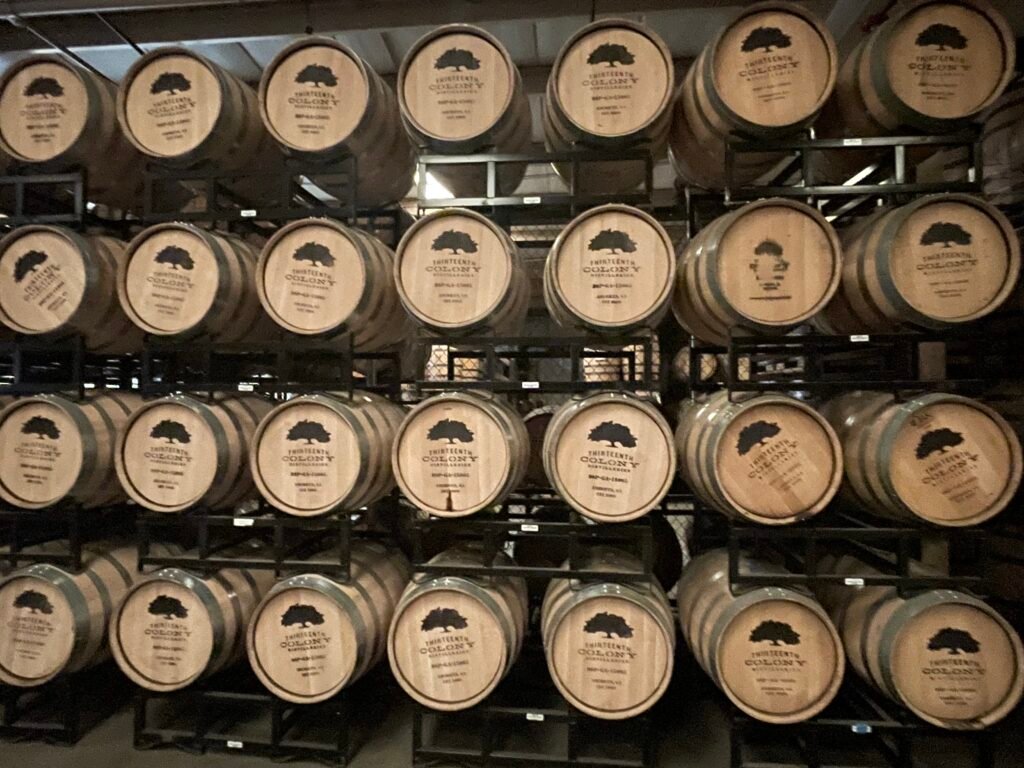
The flagship Southern Bourbon and Southern Rye, for example, don’t carry prominent age statements. That doesn’t mean they’re immature whiskeys. According to the distillery, Arthur evaluates barrels after at least four years of maturation and typically blends barrels between four and six years old for each batch.
The philosophy is straightforward:
Time matters. Flavor makes the final decision.
That same thinking extends throughout the aging program. 13th Colony works with traditional maturation, secondary oak, French oak spirals, maple wood finishing, cask-strength releases and blending to produce different expressions from a recognizable house philosophy.
Some whiskey is distilled at 13th Colony, while other whiskey is distilled elsewhere to the company’s specifications and then matured, selected, blended, finished and bottled in Americus. Max Darby publicly discussed that approach in connection with the 2026 Barrel Symphony release.
The distinction is important.
13th Colony’s identity isn’t based solely on where distillation begins.
Much of it is about what happens to those barrels after they reach South Georgia.
In the Glass: The 13th Colony Lineup
The point of a Route One Corridor story isn’t to reproduce a distillery’s product catalog. But the whiskey itself tells us something about how 13th Colony’s philosophy translates from warehouse to glass.
The Foundation: Southern Bourbon & Southern Rye
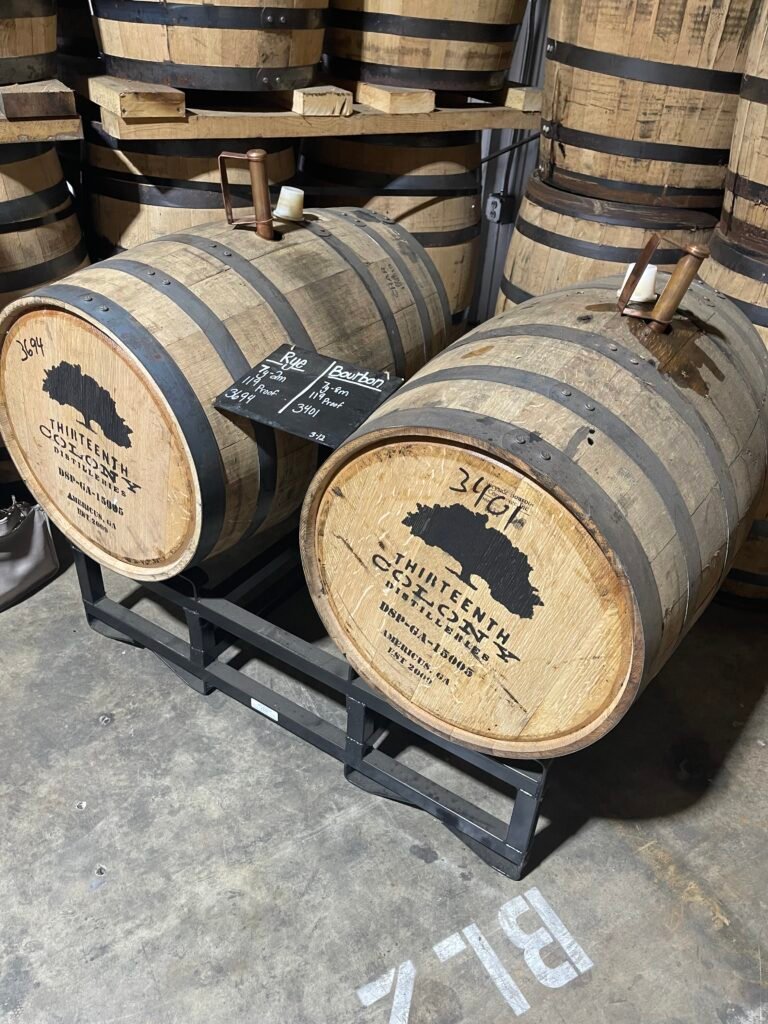
Southern Straight Bourbon is the foundation of the whiskey lineup. Bottled at 95 proof, it uses a mash bill of 70 percent corn, 21 percent rye and 9 percent malted barley.
That relatively substantial rye component gives the bourbon spice and structure while leaving plenty of room for the caramel and honey sweetness drinkers expect from bourbon.
Southern Rye takes the other road. Its mash bill is 95 percent rye and 5 percent malted barley, also bottled at 95 proof, with a toasted French oak spiral finish that adds another layer to the grain’s natural spice.
Together, the two bottles establish the basic 13th Colony vocabulary: sweetness, spice, oak and enough proof to let all three speak clearly.
Turning Up the Volume: 113 & Cask Strength
The 113 Series takes those foundations and pushes them farther.
The bourbon uses the same 70/21/9 mash bill and adds a maple wood spiral finish. The rye applies a similar approach to its 95/5 mash bill. The intention isn’t to create maple-flavored whiskey but to use finishing wood to add another dimension to the underlying spirit.
Then there are the annual cask-strength releases.
Without proofing water tempering the whiskey, these bottlings offer a more concentrated look at the interaction among spirit, barrel and South Georgia maturation.
For someone interested in understanding the distillery rather than simply collecting its releases, tasting the standard and cask-strength versions side by side can be particularly revealing.
Pushing the Boundaries: Double Oaked & Barrel Symphony
This is where 13th Colony becomes particularly interesting.
Double Oaked Bourbon helped bring the distillery to the attention of bourbon enthusiasts well outside Georgia. These releases use older whiskey and additional oak maturation to produce the dark color, concentrated sweetness, spice and substantial oak character that have become associated with the series.
Some individual barrels have been pushed much further. The 2026 Double Oaked Single Barrel, for example, spent 11 years aging in Americus and reached 141.6 proof. Only 150 bottles came from the barrel.
That’s less an everyday bourbon than an experiment in what one barrel, one place and more than a decade of South Georgia weather can produce.
Then came Barrel Symphony: Composition No. 1.
Introduced in 2026, the distillery’s first bourbon-and-rye blend combines 87 percent six-year-old straight bourbon with 13 percent seven-year-old straight rye at 116.2 proof.
It may be the clearest expression yet of Arthur’s chef-like approach to blending. Each whiskey has a job.
In our own Barrel Proof Notes tasting, the bourbon entered first with vanilla and brown sugar before the rye gradually built through the middle and took command of the finish. The flavors arrived distinctly enough that the name Barrel Symphony made sense.
For the full tasting experience, we’ll leave that discussion where it belongs: in the individual Barrel Proof Notes Tasting Note Reviews.
Here, what’s important is what the lineup tells us about the distillery.
13th Colony isn’t standing still.
A South Georgia Whiskey Identity
13th Colony isn’t trying to imitate Kentucky and attach a Georgia address to the bottle.
Its emerging whiskey identity is increasingly tied to Americus.
The climate affects the barrels.
The barrels influence the blending.
The blending determines when the whiskey is ready.
Even some of the distillery’s more experimental products, from French oak-finished rye to maple-finished bourbon, grow from that relationship among spirit, wood, weather and taste.
The company’s history is equally local. It began among friends, remains connected to its founding families, and continues to work from a practical warehouse rather than a carefully manufactured version of Southern authenticity.
There is something refreshingly honest about that.
13th Colony has grown, expanded its distribution and earned attention far beyond Georgia, but its basic philosophy remains remarkably close to the original idea:
Make good spirits.
Share them with friends.
Take enough time to enjoy the moment.
Why 13th Colony Matters to the Route One Corridor
There are larger distilleries.
There are older whiskey brands.
There are producers with more barrels, bigger visitor centers and substantially larger marketing budgets.
That’s not why we’re here.
The Route One Corridor exists to find places where geography, history, people and whiskey intersect in ways that deserve more attention.
By that measure, 13th Colony belongs near the top of the list.
This isn’t simply Kentucky-style whiskey with a Georgia address attached to it. Increasingly, its identity comes from what happens in Americus: the South Georgia heat, humid warehouses, aggressive barrel interaction, whiskey selected by taste rather than age alone, and the people deciding what those conditions have created.
It is also exactly the kind of distillery the Route One Corridor was created to find.
Independent.
Regional.
Rooted in its community.
Serious about its whiskey.
And interesting enough that bourbon drinkers outside its home state ought to know the story.
Kentucky will always be central to the American bourbon story. We wouldn’t want it any other way.
But American whiskey has never belonged to one state, one tradition or one road.
The Route One Corridor is where Barrel Proof Notes leaves the interstate to find the stories happening beyond the industry’s brightest spotlight.
13th Colony is one of the best examples we’ve found.
Good whiskey has never belonged to only one road.
Sometimes the road to good whiskey runs through Kentucky.
Sometimes it leads to a hot warehouse in Americus, Georgia, where the doors are open and South Georgia is doing its share of the work.
I started reading the articles on the Barrel proof notes especially on the 13th Colony Distilleries article. Now I’m ready to buy some of their whiskies. Great article!
Thank you for the comment. 13th Colony has some excellent bottles to choose from. Let us know what you end up with and how you like it.